
The best ways to prepare an autistic child for starting secondary school
Prepare for secondary school by answering your child's practical questions, sharing useful support information and checking the first weeks.
The short answer
Map the parts of secondary school that will be new for your child, then ask which information or practice would help. Cover the route, entrance, timetable, equipment, lunch, toilets, unstructured time and how to get help, but do not make them rehearse every possibility. Ask the current and new schools to agree a useful handover with you and your child. Once term begins, check whether the planned support happened and what difference it made.
What helps, in short
- Start with your child's questions and their preferred way of receiving information.
- Map the actual route through the first day instead of assuming which changes will be difficult.
- Share current support, communication and useful observations with the new school.
- Name the adult, place or method your child can use when they need help.
- Practise one real task at a time and stop if rehearsal is adding more worry than clarity.
- Review the first weeks against what was agreed rather than assuming the handover worked.
The move to secondary school may bring a different journey, entrance, timetable, set of adults, homework system and way of asking for help. Some changes may matter greatly; others may barely register.
Useful preparation finds out which is which. It gives your child usable information and makes sure the new school knows what support should be in place.
Map your child's actual move
Avoid starting from a standard list of what autistic children find difficult. Start with this child, this school and the route through their day.
Together, look at what will stay familiar and what will change. Questions might include:
- How will they travel, and where will they enter?
- What happens between arriving and the first lesson?
- Will pupils move rooms, or will some lessons stay in one base?
- Where are the toilets and lunch spaces they can use?
- How will they read the timetable and know which equipment to bring?
- What happens at break, lunch, assembly and the end of the day?
- How is homework set, recorded and handed in?
- Who can they contact, and how, if they are lost or need help?
Do not fill an unknown with a confident guess. Keep a short list for the new school and replace each question with an answer as you receive it.
Build a practical first-day plan
Walk through the first day only as far as the information is useful. A simple plan might say:
- Leave home at 8.00 and take the number 12 bus.
- Use the side entrance beside the library.
- Go to tutor room B14.
- Show the office card or message Ms Patel if the route changes.
- Meet Dad by the same side entrance at 3.10.
Add the details your child needs, not every detail the adults possess. Check practical problems while there is time to solve them: uncomfortable uniform, carrying equipment, using a locker, paying for lunch, finding a quiet toilet or knowing what to do if transport is late.
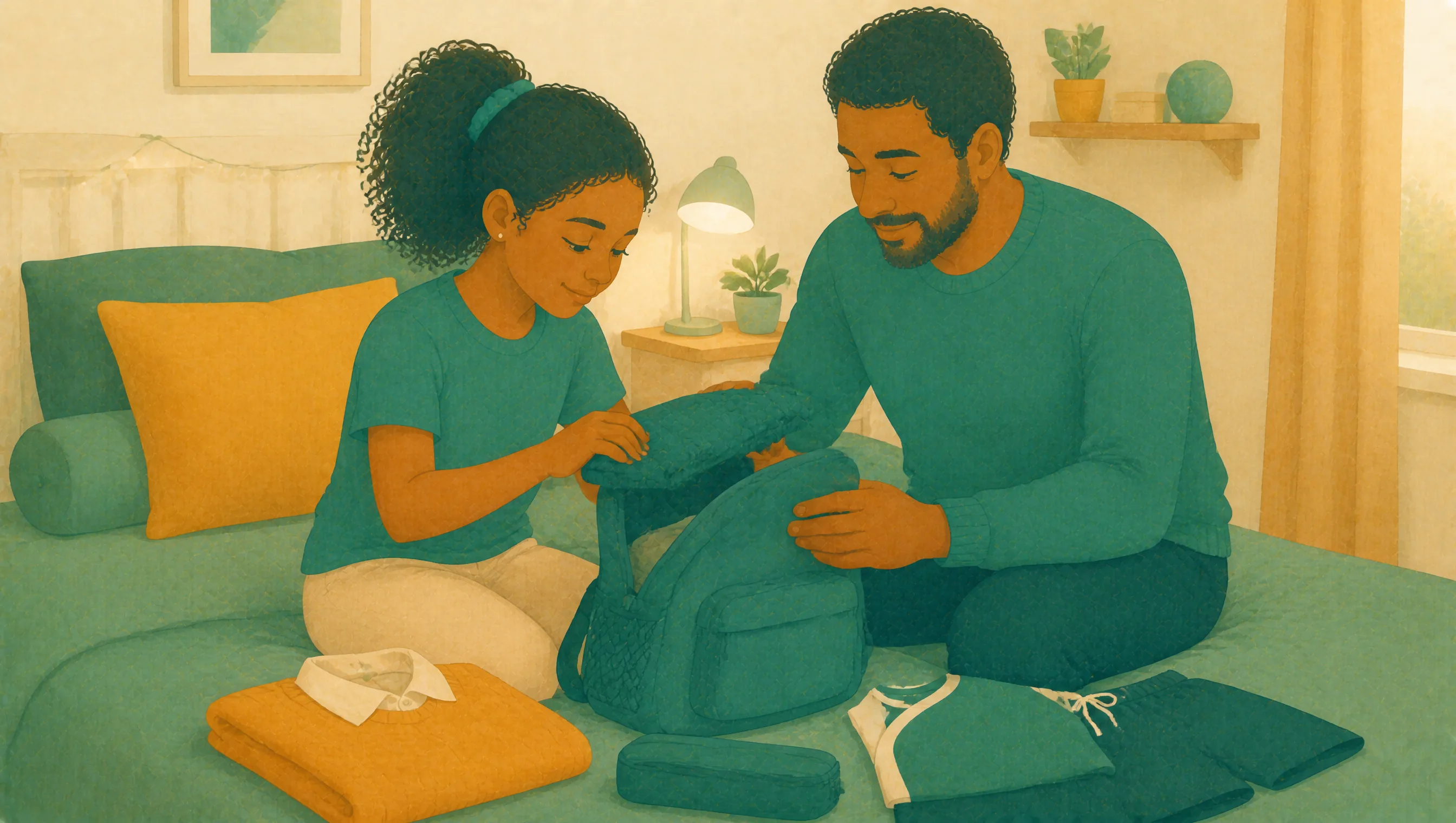
Practise one real task at a time. That may be making the journey, reading one day's timetable or packing for PE. Practice can reveal a missing instruction, but it cannot guarantee that the first day will feel easy. Keep, adjust or stop each preparation according to whether it is helping.
Make the handover specific
The SEND Code of Practice for England says SEN support should include preparation for transitions between phases of education. It says the current school should share information with the receiving setting and agree with parents and pupils what will be shared [2]. The National Autistic Society also advises parents to ask the previous school to pass information about the child's educational needs to the new school [1].
A useful handover is short enough to use and specific enough to act on. It may cover:
- your child's preferred name, communication and way of receiving instructions
- what they would like staff to know about them
- support and adjustments currently in place
- signs that a task, environment or interaction is becoming difficult
- what has helped in similar situations
- health, medication or safety information the school needs
- the person's role in arranging each part of the support
- the date when the arrangement will be checked
Separate observation from explanation. “Sam uses written instructions after a verbal whole-class direction” is clearer than “Sam does not listen.” “The dining hall was not accessible on three recorded visits because of the noise” gives the new school a practical question to answer.
Ask the current school what it has sent, and ask the new school who has received it. A handover meeting is not the outcome. The outcome is that the relevant adults can find the information and the agreed support happens.
Agree how help will work
“Go to a safe place” is only useful if your child knows where it is, when they may use it, how to get there and what happens next. The same applies to a key adult. Find out what your child should do if that person is teaching, absent or on the other side of the school.
Ask the new school to make the route to help concrete:
- the named person or role
- where they can usually be found
- a backup contact
- whether your child can use a card, message, pass or agreed phrase
- where your child waits and who checks on them
- how they return to the lesson or move to the next part of the day
Your child may never use the arrangement. It still needs to be workable if they do.
Check the first weeks against the plan
Do not assume that a quiet first week proves the transition is settled, or that a difficult afternoon proves the placement is failing. Look for what happened in the particular situation.
Keep brief notes on attendance, arrival, lessons, unstructured time, eating, sleep, physical symptoms, homework and recovery after school. Include easier days and what was different. Ask your child what they want changed, and compare their account with what staff observed.
At the first review, return to the agreed actions:
- Did the information reach the relevant staff?
- Was the named support available when needed?
- Which part of the day remains unclear or inaccessible?
- What helped, and under what conditions?
- What will continue, change or stop?
- Who is responsible, and when will you review it again?
The article on starting a new school year has more on the first weeks and after-school recovery. If attendance itself becomes difficult, read what to do when your child cannot get into school.
Sources and further reading
- National Autistic Society, Starting or switching school, accessed 3 August 2026.
- Department for Education and Department of Health and Social Care, SEND code of practice: 0 to 25 years, particularly paragraph 6.57 on transition, last updated 12 September 2024.
Sources and further reading
- [1] National Autistic Society. Starting or switching school (accessed 3 August 2026).
- [2] Department for Education and Department of Health and Social Care. SEND code of practice: 0 to 25 years. Last updated 12 September 2024 (accessed 3 August 2026).
The Family Reset System
Need more than one answer?
Membership opens the full FamilyFX Library and brings the articles together with eight modules, fourteen deep guides, practical packs, document-building tools and My FamilyFX. It costs £79.99 a year, and NeuroFX patients can use an access code for a free first year.
See what is included →