
How do I stop the daily fight over packing the school bag?
A short school-bag sequence that separates school information, prepared items, the child’s check and the adult responsibilities that remain.
The short answer
Give school-bag packing one time, one place and one current information source. Separate adult jobs, such as reading school messages, washing kit or supplying medication, from the child's packing steps. Put prepared items in a current-action tray beside the bag; do not mix them with forms still awaiting an adult. Use a short day-specific list and a visible check, then move the completed bag to the launch point. If an item is unavailable, record who will resolve it instead of repeating the whole list. Review missing items with school when instructions arrive late or through several systems. Independence may include a checklist and adult verification, especially where the consequence of forgetting is high.
What helps, in short
- Use one packing time, place and trusted information source.
- Keep prepared items separate from unresolved adult actions.
- Give every adult and child step a named owner.
- Move the checked bag to the launch point so finished is visible.
The school bag often fails before anybody touches it. PE information sits in an app, a form is unsigned and a book remains downstairs. The child then receives “pack your bag” as if the missing system were one action.
Give packing one place and time
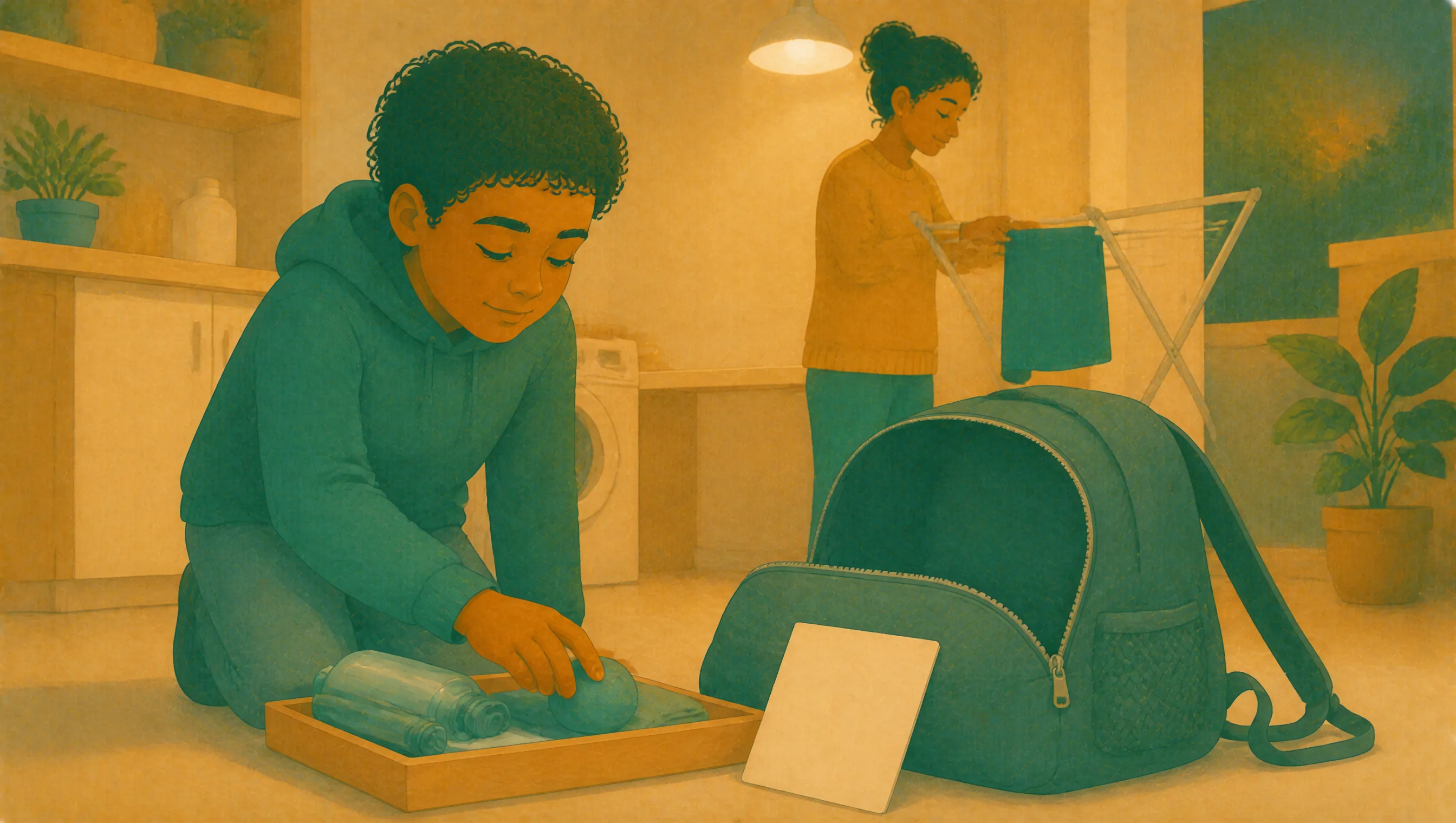
Choose an evening or after-school point that leaves time to resolve a missing item. Put the open bag, current list and ready-item tray together.
The tray contains only things that can be packed. A form awaiting a signature belongs in an adult-action place until it is complete.
Choose one current information route
Decide who reads school platforms, email and paper messages and transfers required items to the child's day-specific list. Do not expect the child to reconcile several incomplete sources unless that is an explicitly taught, supported responsibility.
Name the day and unusual requirement:
- Monday timetable books;
- charged device and cable;
- PE kit in named pouch;
- completed form;
- communication or sensory equipment;
- food, drink or health items with adult oversight.
NHS ADHD guidance suggests a visible to-do list and clear instructions one at a time [1]. NICE includes written reinforcement and environmental modifications in ADHD support [2]. Neither prescribes a school-bag design.
Assign the hidden adult jobs
Write who washes kit, buys supplies, charges shared equipment, handles medication, reads school changes and checks high-consequence items.
The child may pack a pouch while an adult verifies medicine or an inhaler. That is supported independence, not failure.
If an item is unavailable, put one named action on the correct person's list: “Dad prints form by 7.30.” Do not leave the child cycling through the whole bag check.
Make finished visible
The child checks each line against the physical contents, closes the bag and moves it to the launch point. A packed bag left open on the bedroom floor does not clearly show that the operation has ended.
Keep the checklist short and current. A photograph may help for stable pouch contents; a daily list is better for changing books. The guide to a usable checklist helps match format to the job.
Structured organisation interventions for middle-school pupils with ADHD have taught materials management through repeated, multi-part support [3]. One home checklist is not equivalent to that intervention and is not guaranteed to change ADHD-related difficulty.
Ask school to carry its part
A home system cannot repair instructions that arrive after the bag is packed, equipment lists spread across several platforms or sanctions for an item the child was never told to bring.
Show school the repeated break point. Ask for one reliable route, enough notice and an accessible way for the pupil to record changes before leaving. If lockers, classroom transitions or end-of-day packing are part of the loss, the support must also operate at school.
Keep spare low-cost items at school where the school agrees and the child can retrieve them. This is contingency, not permission for adults to stop teaching the information route.
Keep the list respectful
A teenager may prefer a phone list, photograph inside the wardrobe or private bag divider. Involve them in the wording and location. Avoid a public chart that feels childish or exposes health and personal information.
Review the list when the timetable changes. Remove obsolete items instead of adding another note. The shortest accurate list is more usable than a permanent catalogue of everything school has ever requested.
Review the failure, not the child
When something is missing, ask where the route broke: school information, adult preparation, list, retrieval, packing or checking. Change that point.
The wider article on bedroom and bag organisation covers storage and paper transfer. The departure guide takes over once the checked bag reaches the launch point.
The aim is a bag whose current contents can be found and verified, with adult responsibility still visible. It is not a nightly test of whether the child can remember a changing school system unaided.
Sources and further reading
- [1] NHS. ADHD in children and young people. Page last reviewed March 2025 (accessed 4 August 2026).
- [2] NICE. Attention deficit hyperactivity disorder: diagnosis and management. 2018; last reviewed May 2025 (accessed 4 August 2026).
- [3] Langberg and colleagues. Evaluation of the Homework, Organization, and Planning Skills intervention for middle school students with ADHD. 2012; PubMed record 2014 (accessed 4 August 2026).
The Family Reset System
Need more than one answer?
Membership opens the full FamilyFX Library and brings the articles together with eight modules, fourteen deep guides, practical packs, document-building tools and My FamilyFX. It costs £79.99 a year, and NeuroFX patients can use an access code for a free first year.
See what is included →