
Is it my child or the setting? Spotting a mismatch between demands and needs
How noise, pace, language, uncertainty, social pressure and task design can make behaviour differ between settings, with practical ways to test the mismatch.
The short answer
Behaviour that appears in one place and not another often reflects a difference in demands, support or recovery rather than a different child. Compare noise, light, crowding, pace, language, predictability, task length, social exposure, movement, hunger and the help already built into each setting. Include what happens afterwards: a child may complete the school day and release the cost at home. Change one feature while preserving the necessary outcome, then review participation, distress and recovery as well as completion. An environmental explanation does not rule out a developmental, mental-health or physical-health need, and an adjustment is not proof that all expectations should disappear. It shows which conditions make access more possible.
- Different behaviour across settings is information, not proof that one account is wrong.
- Compare hidden support and aftermath as well as visible demands.
- Change one environmental feature and measure the whole effect.
- Keep necessary outcomes while altering inaccessible delivery.
- Sudden change or signs of illness still need health consideration.
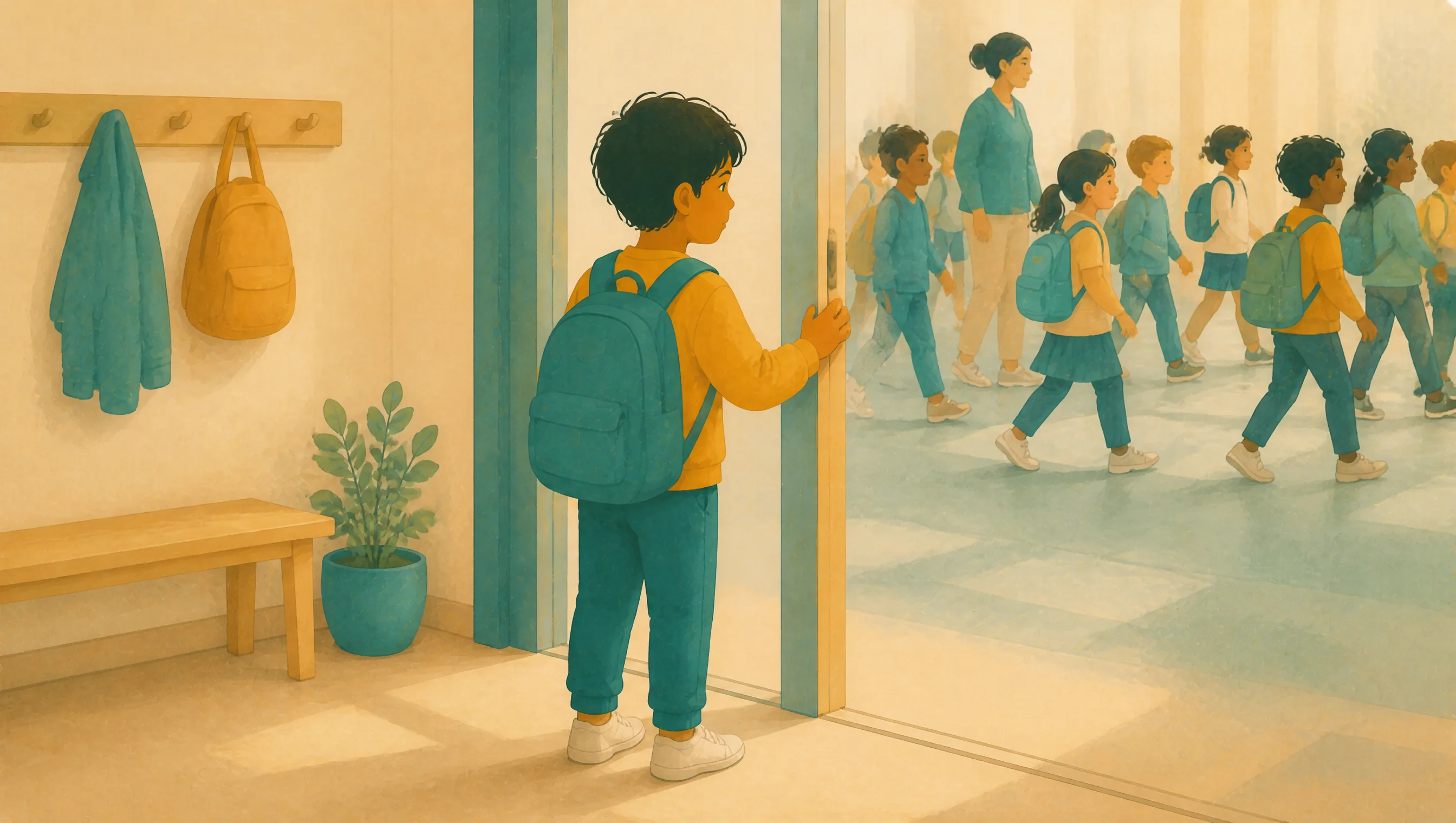
A child completes written work in a quiet support room and tears the worksheet in a busy class. They chat throughout dinner at home and say nothing in a restaurant. They enter school through a side door and cannot move through the main entrance.
The task may look the same to an adult. The child's total demand is not.
Replace “they can do it elsewhere” with a comparison
Success in one setting proves that the child can access the task under those conditions. It does not show which conditions were doing the support.
Compare:
- number of people;
- sound, light, smell, touch and visual movement;
- pace and time pressure;
- spoken-language length;
- predictability and warning;
- task size and motor demand;
- social exposure and fear of error;
- movement and break access;
- hunger, pain and fatigue;
- adult prompts and proximity; and
- recovery available afterwards.
“Writes in the library but refuses in class” becomes: “Writes ten sentences from a printed prompt with one adult in the library. In class, copies from the board while 28 pupils are talking and stops after the second line.”
That description gives adults something they can change.
Look for support hidden inside ordinary routines
Home may appear less structured than school and contain extensive invisible support: a parent repeats information, lays out clothes, reads early signs, changes the pace and allows recovery without naming any of it.
School may also supply hidden structure: a visual timetable used by the whole class, peers beginning the task, materials already placed, the same bell and sequence each day, and adults who give short instructions.
When comparing settings, ask what another person, object or routine is holding for the child. Do not count only formal adjustments.
NICE ADHD guidance describes environmental modifications such as changes to seating, lighting, noise, classroom placement, written instructions and shorter focus periods [3]. Those examples are ADHD-specific guidance, but they illustrate how performance depends partly on task delivery.
Include the cost that appears later
A child can meet an expectation and still exceed a sustainable level of effort. School sees completion; home sees silence, irritability, sleep difficulty or an evening with no capacity left.
The guide to coping at school and struggling at home examines that pattern in depth. For a setting comparison, record what happens in the next hour as well as the moment itself.
Ask:
- Could the child eat, communicate and travel afterwards?
- Did they need substantially more adult support later?
- Was the same task possible again that day?
- How long did recovery take?
- What did the child say once they were settled?
Compliance followed by collapse is not the same outcome as accessible participation.
Compare the demand, not only the place
“School” and “home” each contain many environments. Break time differs from a maths lesson. The kitchen before school differs from Sunday afternoon. A supermarket checkout differs from a quiet aisle.
Map the exact sequence:
enter changing room, find peg, undress near peers, tolerate noise and smell, remember kit order, change quickly, store belongings, move to the hall.
The child may enjoy PE and be unable to access the changing process. Calling the whole subject a refusal hides the mismatch.
Environment includes social conditions
Sensory features matter, but setting is not a synonym for noise. Social uncertainty, being watched, unclear authority, teasing, rapid turn-taking and the risk of public correction can change capacity.
Language can also make a setting inaccessible. “You know what to do” may refer to a routine the child has not inferred. A busy adult may use indirect phrases, several instructions or a question that functions as a command.
NICE autism guidance asks professionals to consider communication, the physical and social environment, changes, predictability and structure when behaviour becomes challenging [1]. It also includes pain, mental health and other developmental needs, so an environmental account should not become the only account.
Use a mismatch statement
Write three parts:
In this condition, the task requires these skills or tolerances, while the child currently has access to these supports or capacities.
For example:
At the main gate between 8.40 and 8.50, entry requires moving through a dense, noisy crowd and separating quickly. Arlo currently enters when the path is clear, the same adult meets him and he can see the first classroom task.
This statement does not label Arlo avoidant or the gate bad. It identifies the access gap.
Change one feature while keeping the outcome
If the outcome is arriving at school, possible trials include a quieter entrance, a five-minute timing change, a named greeter or the first task sent in advance. The educational outcome remains.
If the outcome is showing knowledge, change copying, handwriting, spoken-response pressure or task length while retaining the learning question.
If the outcome is joining a family meal, alter seating, smell, duration or conversation load without requiring eating a particular food as proof of participation.
NICE guidance for people with a learning disability whose behaviour challenges recommends changing environmental conditions, increasing predictability and adjusting task demands within function-informed support [2]. The guidance is population-specific; an ordinary trial should remain proportionate and should not be presented as a clinical intervention.
An effective adjustment can reveal the next barrier. Once a quieter entrance makes school entry possible, the child may still struggle with the first classroom instruction. That does not mean the entrance change failed. It means adults can now see a part of the sequence that was previously hidden behind the larger obstacle.
Keep successful features in place while testing the next change. Removing the quieter entrance to check whether the child has "learned to cope" confuses access with treatment. If greater independence is a shared goal, reduce support gradually, with the child informed, and restore it when the result is increased distress or loss of participation.
Consider the effect on dignity and belonging. An adjustment that works technically may mark the child out, remove them from friends or require repeated public explanation. Ask whether the same function can be delivered more discreetly or made available to everyone. The best environment is not simply the one in which adults see less behaviour. It is one in which the child can participate, communicate and remain recognisably themselves.
Measure access, not quietness
After the change, record:
- whether the child could begin and remain;
- communication available;
- prompts and adult effort;
- distress and safety;
- completion where relevant;
- effect on others; and
- recovery.
A separate room may reduce disruption and increase isolation. Headphones may reduce sound and block instructions. One-to-one support may increase access and social pressure. Review the whole effect.
Use the one-week observation log when the pattern is unclear. Include comparable moments without the difficulty.
Turn a home-school disagreement into a joint enquiry
When one setting sees difficulty and another does not, begin with a shared question rather than asking who is correct:
What is different about the demand, support and recovery in the moments when this child can and cannot take part?
Ask school to choose one accessible lesson and one difficult lesson. For each, record the first instruction, group size, location, copying or motor load, support, transitions and what happens at break or home afterwards. The parent can make the same comparison for a related task at home.
Avoid using broad reports such as “fine all day” or “always dysregulated after school”. A short sequence is easier to compare:
In science, Priya receives the worksheet on her desk and begins when her partner starts. In English, she copies the date and learning objective from the board, misses the spoken instruction while copying and then walks out when asked why she has not begun.
The comparison suggests a trial involving printed task information and reduced copying. It does not require either adult to decide whether Priya is capable, anxious, inattentive or oppositional before support begins.
Agree who will make the change, when it starts and what will be reviewed. Ask the child privately whether the plan makes the task easier or merely makes their difficulty less visible. If the adjustment works in one lesson, consider which feature transfers to other settings rather than copying the entire arrangement everywhere.
Record disagreement that remains. A useful meeting can end with two possible explanations and a safe way to gather better evidence. False agreement is less valuable than a precise unanswered question.
Keep the child's account central
Ask specific questions: “Was it the crowd, not knowing who would meet you, leaving me, or something else?” Offer the option to answer later or through writing, pictures or choices.
The child may identify a factor adults missed, such as a peer near the entrance or fear that arriving differently will attract attention. An adjustment designed without them can solve the wrong problem.
Do not require the child to tolerate the inaccessible version repeatedly to validate their account. Use existing observations and safe trials.
A mismatch is not a complete diagnosis
Improvement after an environmental change does not establish autism, ADHD, sensory processing difference or anxiety. It shows that the changed feature mattered in that task.
Persistent difficulty may still warrant assessment of communication, learning, motor, mental-health and physical-health needs. Sudden change, pain, loss of skills or altered awareness needs medical consideration rather than a longer environmental experiment.
A useful next step
Choose one task that differs between two settings. Make two columns for demands, hidden support and aftermath. Circle one difference you can change safely this week.
Keep the necessary outcome clear, trial the change and ask the child what it altered. The aim is not to decide whether the problem belongs to the child or the setting. It is to make the fit between them more workable.
Sources and further reading
- [1] NICE. Autism spectrum disorder in under 19s: support and management (accessed 4 August 2026).
- [2] NICE. Challenging behaviour and learning disabilities: prevention and interventions (accessed 4 August 2026).
- [3] NICE. Attention deficit hyperactivity disorder: diagnosis and management (accessed 4 August 2026).